
‘Genius’ video shows Theresa May in Monty Python and the Holy Grail

Many have been amused by a new video showing Theresa May as King Arthur in Monty Python’s Holy Grail, made by Australia’s ABC.
The Insiders team made a supercut of many of the Prime Minister’s most stirring soundbites from the general election.
In the clip, Theresa May calls a general election:
Lord Buckethead also makes an appearance as the Black Knight.
This is how the Australians apparently see our relationship with our European neighbours:

Scrap extra fees for international students and use foreign aid budget to bring them to UK, professor urges

The Independent Online.
International aid money set aside to help impoverished and war-torn countries should be used to bring overseas students to the UK post-Brexit, a university academic has suggested.
Len Shackleton, a professor of Economics at the University of Buckingham, said the higher tuition fees currently asked of foreign students is “extortionate” and should be scrapped altogether to encourage applicants.
Instead, the Government should take money from the Department for International Development (Dfid) to recruit candidates and enable student mobility.
Bright, underprivileged students from across the globe could be funded to study in the UK, and young Brits should also be given access to loans if they wish to study abroad.
Presenting the ideas at an education conference at the University of Buckingham, he said: “We’ve got Dfid sitting on huge sums of money – why not direct some of it towards bringing third world students to UK universities?”
In order to “plug holes”, any leftover funding should be available to promote research collaborations anywhere in the world, he added.
He later told The Independent: “We’re committed to spending 0.7 per cent in GDP every year and we can’t spend it.
“It ends up in corrupt payment, in schemes that don’t do anything, in consultancy fees which run into the millions of pounds.
“Why not divert some of that money to perhaps having two-stage fee levels for different countries. Certainly it would compensate in a way for the things that are happening [to higher education] by opening out to the wider world the opportunity of studying in the UK.”
His comments follow on from frequently voiced concerns among industry members about the future of the UK’s reputation as a hub for higher education and research.
Student Loans Mythbusting: The truth about uni fees, loans & grants

By Martin
Ignore newspaper headlines about students leaving university with £50,000 of debt. That’s a mostly meaningless figure. What counts is how much you’ll repay; for some that’s far more, for others it’s free.
This guide is written to bust common myths about student loans, grants and finance, including the 20+ key facts every potential student, parent and grandparent should know.
20+ student loans mythbusting tips, including…
The information in this guide is for those starting university in 2017. Future policy may change.
Before we start, I’d just like to say:
For 23 years we educated our youth into debt when they go to university, but never about debt.
It was for this reason, and while no fan of them, when massive changes were announced to student finance for those starting in 2012 or beyond – including the trebling of tuition fees – I agreed to head up a student finance taskforce. The idea was to work with the National Union of Students, universities and colleges to ensure we busted the myths and misunderstandings that resulted from so much political spittle-flying.
For me what really counts is that no student is wrongly put off going to university thinking they can’t afford it. Some may rightly be put off, but unless you understand the true cost, how can you decide? I hope this guide helps achieve that.
Thankfully, since then, we’ve also won a separate campaign to get financial education on the senior school National Curriculum in England. Yet it’ll be a long time before that truly pays dividends – so there’s still a lot of nonsense spoken about student loans.
Don’t confuse the cost and the price tag
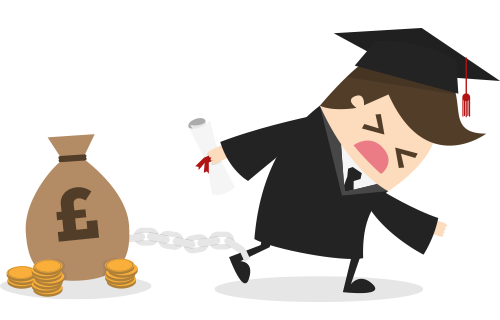 With headlines shouting about £50,000 student debt and that getting bigger as living loans increase in 2017, it’s safe to say many students and parents are scared by this huge sum – and worry about how they’ll ever repay it.
But in essence that fear is misplaced. That’s because the price tag of university is mostly irrelevant. What matters in practical terms is how much you have to repay – and that’s a completely separate number from the total amount of tuition fees, maintenance loan and interest, because it all depends on what you would pay.
What you repay solely depends on what you earn after university. In effect this is, financially at least, a ‘no win, no fee’ education. Those who earn a lot after graduating or leaving university will repay a lot. Those who don’t gain too much financially from going to university will repay little or nothing.
This guide applies to the system started in England in 2012
If you started before that you’re on a different system; please see the Should I repay my student loan? guide for full info on past loan systems.
You don’t need the cash to pay for university
It ISN’T a case of ‘pay up or you can’t go’. Once your application has been processed, tuition fees are automatically paid by the Student Loans Company. And there is a loan for living costs too.
Full-time students only need to start repaying these at the earliest in the April AFTER they graduate (or leave), no matter how long their course is.
Of course you don’t have to take these loans, you could pay the tuition fees directly. Yet as you’ll see (in point 15) that’s often a bad idea.
However, some students won’t get the same support as the majority…
If you already have a higher education qualification
If you’re wanting to study health care or medicine?
If you’re a Muslim student
You repay 9% of everything earned above £21,000 – earn less and you don’t repay
Once you leave university, you only repay when you’re earning above £1,750 a month (equivalent to £21,000 a year) and then it’s fixed at 9% of everything you earn above that. Earnings mean any money from employment or self employment and in some cases earnings from investment and savings.
Even if you’ve started repaying the loan, but then lose your job or take a pay cut, your repayments drop accordingly. To labour the point somewhat:
- If you earn £22,000 in a year, what do you repay?
The answer is £90, as £22,000 is £1,000 above the threshold and 9% of £1,000 is £90.
- And if you earn £31,000, what do you repay?
The answer is £900. £31,000 is £10,000 above the threshold and 9% of that is £900.
- ‘How on earth will my child be able to afford to repay these debts if they get a poorly-paying job?’
This panicked question has been thrown at me by many parents – and it’s really important to examine it in the light of the required repayments.
Someone on a low wage will be required to repay little or nothing at all. In fact, only higher earners will be shelling out large amounts.
It’s important to note that not repaying much because you’re just over the threshold isn’t being bad. The system is, in reality, a graduate contribution, designed so that, in the main, those who gain the most financially out of university contribute the most.
- The £21,000 threshold was supposed to rise in 2017 – now, IT WON’T
When the changes to student finance were announced in 2012, it was repeatedly stated by the Government that the £21,000 threshold would rise in line with average earnings in April 2017. In November 2015, it did a U-turn, saying the threshold would be frozen until at least April 2021.
This effectively hikes the cost of student loans for most students – and because it changed not just for future students but for those who were already studying, it is a retrospective hike. As a simple explanation, if you earn £22,000 with the threshold at £21,000 you pay £90 a year – if the threshold had gone up as expected, to £22,000 for example, you’d repay nothing.
The only people who gain from this are those who earn such huge amounts that they’d clear their entire loan within 30 years (as this is when it’s wiped). More explanation on this in my video in student loan threshold to be frozen.
Further info on repaying
Technically you repay 9% above £1,750 a month – important if you get bonuses
What counts as additional income for student loan repayment purposes?
How are student loans treated for tax purposes?
Do I still have to repay my student loan if I move overseas?
How do student loan repayments affect my pension contributions?
After 30 years, any and all remaining debt is wiped
 You stop owing either when you’ve cleared the debt, or when 30 years (from the April after graduation) have passed, whichever comes first. If you never get a job earning over the threshold, it means you won’t have repaid a penny.
It’s one reason those who are near retirement, who don’t have a degree and want one, find it very appealing as unless they’ve a huge pension, they know they’ll never have to repay.
What happens on death or incapacity
Many people earning over £21,000 will never pay it all back within the 30 years
By running the numbers on some typical situations using our Student Finance Calculator, it looks likely only those towards the higher end of the income scale will ever repay all of what they borrowed, plus the interest (see later for info on that).
How much will you repay? (2016 starters)
Borrowing £9,000 for fees & £8,200 living costs per year, so £51,600 in total. With 3% inflation & graduate earnings growing at inflation + 2% per year.
| Starting Salary (Sep 2016) |
Salary in 30 years | Total amount repaid | Will I fully repay it? |
|---|---|---|---|
| £10,000 | £41,000 | Nothing (i) | No |
| £15,000 | £62,000 | Nothing (i) | No |
| £20,000 | £86,000 | £15,000 | No |
| £21,000 | £90,000 | £21,000 | No |
| £25,000 | £108,000 | £45,000 | No |
| £30,000 | £130,000 | £75,000 | No |
| £35,000 | £151,000 | £105,000 | No |
| £40,000 | £157,000 | £135,000 | No |
| £45,000 | £185,000 | £149,000 | Yes – 29 years |
| £50,000 | £205,000 | £125,000 | Yes – 24 years |
| (i) Assumes student loan repayment threshold goes up in line with our assumption of average wages increase. | |||
How much will you repay at today’s prices?
Borrowing £9,000 for fees & £8,200 living costs per year, so £51,600 in total With 3% inflation & graduate earnings growing at inflation + 2% per year.
| Starting Salary (Sep 2016) |
Salary in 30 years at today’s prices | Total repaid at today’s prices | Will I fully repay it? |
|---|---|---|---|
| £10,000 | £17,000 | Nothing (i) | No |
| £15,000 | £27,000 | Nothing (i) | No |
| £20,000 | £36,000 | £7,000 | No |
| £21,000 | £37,000 | £11,000 | No |
| £25,000 | £44,000 | £25,000 | No |
| £30,000 | £53,000 | £43,000 | No |
| £35,000 | £62,000 | £62,000 | No |
| £40,000 | £71,000 | £80,000 | No |
| £45,000 | £79,000 | £91,000 | Yes – 29 years |
| £50,000 | £88,000 | £85,000 | Yes – 24 years |
| (i) Assumes student loan repayment threshold goes up in line with our assumption of average wages increase. | |||
Figures based on the following assumptions:
- Interest is accrued daily and applied monthly.
- Inflation will be 3% each year (Bank of England statistics show inflation for 2000-2010 to be 2.7% and we have rounded it up).
- Graduate salary increase will be RPI + 2% (based on ONS figures 2000 – 2010). This factors in some of an individual’s potential pay increases, through promotions or skills as they get older or more experienced. This differs from overall average earnings increase, which is across the whole population regardless of age.
- Tuition Loan and Maintenance Loan are £9,000 and £5,500 respectively.
- Employment will be gained from Sep 2020, but repayments start April 2021.
And the following facts:
- Debt grows by inflation plus 3% until April 2019.
- Debt increases annually by RPI plus 0.00015% for every £1 you earn above £21,000. From April 2021, this £21,000 threshold begins to increase.
- Income thresholds will be frozen at £21,000 until 2021, then will grow annually in line with earnings (which we’ve assumed as RPI + 1%, based on ONS figures 2000 – 2010).
A helpful video can be found here: Interview
No debt collectors with student loans
All student loans since 1998 have been repaid through the payroll just like income tax. What this means is that once you’re working, your employer will deduct the repayments from your salary before you get it. So the amount you receive in your bank account each month already has it removed.
This means no debt collectors will come chasing as you don’t have a choice in the matter and will have paid it automatically.
‘Above-inflation’ interest will be charged
 Until 2012 there was no ‘real’ cost to borrowing money via student loans, as the interest rate was set at the rate of inflation (RPI). So, borrow a shopping trolley worth of goods and you’ll repay enough to buy the same, even though the actual cash amount may increase (more on this in the Should I Repay My Student Loan? guide). If you don’t understand interest rates? Read the Interest Rates Beginners’ Guide
Yet for everyone who started university since the major changes in 2012 that’s all changed. The interest is as follows:
- While studying:
Accrues RPI inflation plus 3% on the outstanding balance. This continues until the first April after graduation when it changes to…
- After studying, earning under £21,000:
Accrues RPI inflation.
- After studying, earning £21,000 – £41,000:
The interest rate will gradually rise from RPI to RPI plus 3% the more you earn (the interest rises 0.00015% for every extra pound you earn or, put another way, if you earn £1,000 more, you accrue 0.15% extra interest). These thresholds are frozen until 2021, but could rise with average earnings after.
- After studying, earning over £41,000:
Accrues RPI inflation plus 3%.
It’s worth noting all the above scenarios assume inflation is positive (prices rising). It’s not yet known what would happen in a period of deflation (prices falling).
 The rate used is the previous March’s RPI inflation rate. March 2016’s inflation rate was 1.6% meaning interest charged on new-style student loans in 2016/17 is between 1.6% and 4.6% depending on whether you’re studying or graduated, and how much you earn.
March 2017’s RPI inflation rate was 3.1% meaning interest charged on student loans for the 2017/18 academic year will be between 3.1% and 6.1% depending on whether you’re studying or graduated, and how much you earn.
Student loans are interest free for many
I’m no fan of the fact that students aren’t just being charged for their education, they also pay for financing it with above inflation interest.
Yet that’s a principled stance. Being charged interest isn’t the same as needing to repay it. In practical terms for lots of graduates especially those who never become high earners, they’ll never end up repaying any interest, so it’s meaningless. See my Student loans are interest free for many blog.
Part-timers and post-grads can get loans for tuition fees too
Part-time students, often forgotten, make up 40% of all undergraduates. Fees are between £4,500 and some £6,750 (rising to a maximum £6,935 in 2017/18).
Yet since 2012, for the first time, part-time students studying at least 25% of a full-time course have been eligible for tuition fee Student Loans Company loans on exactly the same basis as full-time students.
They aren’t eligible for maintenance loans or grants. However, the Government has announced that by April 2018, it will introduce maintenance loans and support for higher education students wishing to study part time.
The Government need to consult on the exact details of how the schemes will work and we’ll update this guide when we have more information.
Full info on this in my Part-Time Students’ Finance Guide.
Postgraduate students
From 1 August 2016, for the first time, new master’s students are able to apply for Student Loans Company loans of up to £10,000 to pay for their courses – these only need repaying if they earn enough once the course ends.
Full info on this in my Postgraduate Student Loans Guide.
The marketisation of university hasn’t worked – almost all unis charge £9,000
 When student finance was first introduced in 2012, the idea was that there would be some expensive degrees and some cheap degrees and they were charged between £6,000 and £9,000.
Frankly now, almost all universities for full-time students charge £9,000 and they’re going to be allowed to increase with inflation in the future, meaning some 2017/18 starters will pay £9,250 tuition fees.
But it’s worth examining whether this makes a jot of difference to you. Whether you choose a course that costs £6,000 or £9,000, you’ll repay the same amount each month, as it purely depends on what you earn (9% above £21,000).
In other words, whatever your tuition fees (and maintenance loan) if you earn £22,000, and haven’t cleared the debt, you repay £90 a year.
Of course, the more you borrow, the longer you’ll be repaying. Yet it’s worth noting that, as many people won’t finish repaying before the 30 years is up (see key fact 4) unless you’re a higher earner, picking a course with higher fees won’t actually cost you more.
See the min, max and average fees planned to be charged by each university from September 2015 (pages 28 to 32) and try Which?’s university site to help you decide where to go.
You can borrow for living costs too
Full-time students at the start of their course can also take a loan to pay for their living costs, eg, food, books, accommodation and travel. They are known as maintenance loans, and are usually paid in three termly installments direct to the student’s bank account.
The loan is repaid in exactly the same way as the loan for tuition fees (ie, 9% of everything earned above £21,000).
The amount available is dictated by two elements:
- The guaranteed bit
Up to 65% of the maximum living cost loan is currently available to everyone, regardless of their parental income.
- The income assessed bit
The amount you can borrow is means-tested, in other words, it depends on your or your parents’ residual income (pre-tax income minus pensions – see a full definition of residual income).
If income is higher, then you or your parents are expected to fill this financing gap – if they don’t it can be difficult. Feel free to show them this to help explain the way the system works.
Maximum maintenance (living) loan
| Academic year | Living with parents | Living away from home | Living away from home (London) | Living away from home (overseas) |
|---|---|---|---|---|
| 2016/17 | £6,904 | £8,200 | £10,702 | £9,391 |
| 2017/18 | £7,097 | £8,430 | £11,002 | £9,654 |
Maintenance loans now available for the over 60s
It used to be these loans were only available to the under 60s. But from 2016/17, over 60s are able to apply for loans for living costs too. They’ll get up to £1,863 if they stay at home, £2,483 for living away from home and £3,487 if it’s in London and £2,940 for overseas.
Technical education students to receive maintenance loans from 2019
Students taking higher-level technical courses in areas such as construction, digital skills and social care will be able to apply for maintenance loans from the 2019/20 academic year.
The loans will be available to those on technical education courses at levels four to six in national colleges and institutes of technology. Full details of the loans, including maximum amounts and means-tested elements, are yet to be announced, we’ll update this guide when we know more.
My biggest problem is the loan isn’t big enough
While most media outlets like to focus on the headline figure of £50,000 – in real terms the main issue most students face is that the loan isn’t big enough. The amount of money to live off can barely cover accommodation fees in some circumstances.
Therefore, it’s crucial to ensure there is a real focus on budgeting, and you don’t spend the cash the first few weeks of term. Part-time jobs, any grants, extra cash from parents will all help. See Student MoneySaving tips for more on how to make the cash stretch further.
Deadlines to apply for student loans & grants
To get the cash by the start of the September 2017 term, you needed to meet the following deadlines, which change based on where you live:
If you live in England: For new students it was 26 May, for returning students, 3 June.
If you live in Wales: For new students it was 12 May, for returning students, 9 June.
If you live in Northern Ireland: For new students it was 7 April, for returning students it’s 30 June.
Missed the deadline? Don’t worry, you can still apply up to nine months after your course start date for funding but you won’t be certain to get the cash in time for the start of term if you’re late.
If you live in Scotland: For any students, to get funding in time you must apply by 30 June, but if you make any errors on your form, be aware that’s the final cut-off. However if you miss that but apply by 31 March 2018 you’ll get the cash. It’s just not guaranteed in time for the start of your course.
Grants were replaced by larger loans for 2016/17 starters and beyond
In the 2015 Budget the Chancellor announced that from the 2016/17 academic year, maintenance grants would be scrapped, so all of the money for maintenance now comes in the form of a student loan in England.
Existing students at the time will not be affected by this change, ie, those who start(ed) from the 2015/16 academic year or earlier will still continue to get their grants even after 2016.
The silver lining to this cloud is that the maximum borrowing was substantially increased from 2016, though only for new students.
The amount students get depends on their family’s household income, though under the new, larger loans system, only 45-50% of the loan is guaranteed (depending where you study) with the remaining proportion income-assessed, meaning for those studying outside London, only £3,821 of the £8,200 maximum is guaranteed.
This means everyone eligible is entitled to a loan, regardless of how much their parents earn, although only those with a household income of £25,000 or under will be able to get the maximum amounts in 2016/17 of:
- Living at home: £6,904/year
- Living away from home, outside London: £8,200/year
- Living away from home in London: £10,702/year
Get Our Free Money Tips Email!
For all the latest deals, guides and loopholes – join the 10m who get it. Don’t miss out
If your parents earn more than £25,000, they’re expected to contribute
The amount of maintenance loan you get’s based on your parents’ (or household) income. So, if your parents earn more than £25,000 you won’t get the full amount – and the amount you do get is means tested on their income.
Only around 45% of the loan is guaranteed under the new rules, the idea being that your parents should make up the shortfall in loan amount so everyone gets the maximum one way or another.
We’ve put together a table showing how much your parents’ll be expected to contribute at different income levels (though these are suggested – you can’t force them to pay). The amounts differ depending on where you are living…
However, it’s worth noting that if you’re eligible for benefits, there’s more than one university student in your household, or you’ve applied for supplementary support, your parents’ income’s assessed in a different way. Full information’s available in this catchily-titled Financial Memorandum 2016/17.
It’s also worth checking out Martin’s blog on how much the Government expects parents to contribute to their children for university.
Will scrapping student grants stop people going to university?
In practical terms, getting rid of the student grant will only affect high-earning graduates. That’s because after leaving university, students repay 9% of everything they earn over £21,000 for a maximum of 30 years. Those who’d currently qualify for a full grant would only actually pay more if it was wiped, if they’d repay their entire tuition fee, remaining maintenance loan after the grant, and interest within the thirty years before the debt wipes.
A number crunch shows, as a rough rule of thumb, for a student living away from home, taking the full tuition fees, this is only for those on graduate starting salaries substantially above £30,000 who then get above inflation pay rises after that too. That is at the very high end of graduate earnings.
The real risk with ending grants is the fact larger loans can be a psychological deterrent, especially to those from non university backgrounds.
Student loans DO NOT go on credit files
When you borrow from a bank for a credit card, loan or mortgage, to evaluate whether they’ll make money from you lenders look at three pieces of information – your application form, any previous dealings they’ve had with you and crucially, the information on your credit reference files (full info: How Credit Ratings Work).
Most normal financial transactions and credit relationships you have are listed on these files – yet student loans are not included (with the exception of students who started university before 1998 under the original loans system and defaulted).
So the only way loan, credit card or mortgage providers know if you’ve got a student loan is if they choose to ask on application forms. They can do this and it happens, but in general it’s only for bigger value transactions such as mortgages.
Student debt can impact your ability to get a mortgage, but not as much as people think
 I know many parents worry that now we have £9,000 tuition fees the subsequent ‘debt’, will hit their child’s ability to get a mortgage after studying.
Of course, having a student loan is worse than not having one when it comes to getting a mortgage. Though going to university often results in earning a higher salary, which usually cancels this out.
Many worry about the “huge debt” putting lenders off, actually that isn’t a problem, student loans don’t appear on your credit file, so the impact isn’t really about whether you’ll be allowed a mortgage or not.
Where it does impact is in the affordability checks which establish whether you can afford to make repayments on a mortgage. Of course, as you have lower take-home income with a student loan, that means you’ll be assessed as being able to make smaller repayments. For full help see First-Time Buyers Mortgage Guide.
The changes in 2012 had some benefits for those getting mortgages
Many parents’ biggest fear was about the increase in tuition fees from £3,000 to £9,000 back in 2012. Yet actually in some ways the changes were an improvement.
While it’s now a somewhat dated issue, it does merit a mention – and if you understand this explanation then it means you’ve nailed understanding the new system.
If we contrast student loans for those who start now with their 2011 predecessors, while the borrowing is bigger, the repayments are smaller. That’s because recent starters pay 9% over £21,000, while those who started before pay 9% over £17,335.
That means the 2011 cohort lose more of their disposable income, making mortgages far less ‘affordable’.
Yet the fact they repay more each month and have borrowed less mean they’re likely to clear their debt much quicker, so once they’ve repaid it (typically after a decade or so), they then have a bigger disposable income. Thus all in all, for mortgage getting at least, the change was swings and roundabouts.
You can repay student loans early
 In the early days, the Government was consulting on penalties to stop people repaying early – but the mass of feedback (including our no to penalties submission) was against – and thankfully it decided to scrap the idea.
Yet this doesn’t mean you should pay off early, just because it’s allowed. While in general we’d encourage people to repay their debts as quickly as possible, student loans are one of the rare cases where that will be a bad decision for some people.
This is because, as explained in point 18 below, under the new system many won’t fully repay before the debt’s wiped (after 30 years, use the Student Finance Calc to see). Overpaying each month could actually be peeing in the wind – as the overpayment’s not reducing the amount you’d need to pay back at all.
Even if you’ve enough cash to clear the loan in full it may not be worth it as your repayments primarily depend on what you earn, not what you borrowed. It could mean you need to repay less than what you owed. To see how this concept works read the Beware paying Tuition Fees Upfront guide.
Beware paying tuition fees upfront, it could leave you £10,000s worse off
Many parents save up to avoid their children getting into ‘debt’. Even more horrifically, some borrow money themselves so their children won’t need student loans.
That’s a petrifying thought, a student loan is the ‘best’ form of debt you’ll ever get. The interest is relatively low and crucially you only need to repay it if you earn enough.
Yet even if you’ve got the savings anyway it can be very bad financial logic. Let’s take a look…
An example:Paul wants to study agricultural sciences. His parents decide they don’t want him getting the tuition fee loan and shell out £27,000 of their hard earned cash to pay his tuition fees, and give him £20,000 to live off over three years.
He graduates and wonderfully decides to go and work for a charity based in Africa for 10 years, where he never earns over £21,000. Then he comes back, gets married and becomes a full-time parent of their three children.
They paid £48,000 for money Paul will never need to repay. In fact, they’d have been far better off to save the money towards a mortgage deposit for him, as that’s a far more difficult task..
Of course, I’ve given you an extreme example, but if you are considering paying tuition fees up front, it can still be a waste of cash even for those who earn well over £21,000 after university. If you’re considering this read my full Beware Paying Tuition Fees Up front guide, which takes you through the pros and cons.
Martin Lewis
MSE founder &
chair
Students from, or going to, Welsh, Scottish and Northern Irish unis may have different rules
Scottish, Welsh and Northern Irish students, including those who decide to study in England, receive their financial support from their “home” devolved administration so it’s a matter for those governments to decide how they wish to support their students.
- Scotland:
Scottish students studying in Scotland pay no tuition fees. English and Northern Irish students studying there will be charged up to £9,000 per year, as will Scottish students studying in England, Wales and Northern Ireland. Welsh students in Scotland will receive some support from the Welsh Government – see below for details.
More info: Student Awards Agency for Scotland
- Northern Ireland:
Northern Irish students studying in Northern Ireland paid a fixed price of £3,805 in 2015/16. Those from England or Scotland will be charged up to £9,000 per year, while Welsh students will receive some support from the Welsh Government, as explained below.
More info: Student Finance ni
- Wales:
Tuition fees at Welsh universities follow the English pattern and were increased to £9,000 from 2012. However, the Welsh Government covers the increase for Welsh resident students. They won’t have to pay any more than £3,810 a year. English, Scottish and Northern Irish students will need to pay the full amount.
More info: Student Finance Wales
Here’s a summary of the situation for 2016 starters:
Maximum annual tuition charges
| Where student is studying | ||||
|---|---|---|---|---|
| Where student lives | England | Scotland | Wales | Northern Ireland |
| England | Up to £9k | Up to £9k | Up to £9k | Up to £9k |
| Scotland | Up to £9k | Free | Up to £9k | Up to £9k |
| Wales | Charged up to £9k, but Welsh Govt pays anything above £3,900 | |||
| Northern Ireland | Up to £9k | Up to £9k | Up to £9k | £3,925 |
| Source: Ucas | ||||
The very highest earners aren’t the very highest payers
 Throughout this guide, I’ve explained that the more you earn the more you repay. Yet a quirk of the system means technically, beyond a certain point, that’s not true.
In truth, for the huge majority of people this isn’t relevant, so feel free to skip this technical point, but I add it in for technical correctness and because from a political perspective it is worth examining.
This quirk happens because seriously high earners pay off so quickly they have less time to accrue interest. If we take a ludicrous example to prove the point, if someone earned a billion pounds in their first month of work, they’d have cleared the debt in one month, so no interest would’ve accrued.
Of course they still repay far more in total than low earners, but it does mean rather perversely that very very high earners repay less than high earners.
Try a wee experiment to see this. Go to the Student Finance Calculator and set it to the maximum tuition fees (£9,000 per year) and typical maintenance loan (£5,740 per year). Now use the salary slider to change the starting salary and (on standard assumptions of inflation and salary growth) you’ll see at first the repayments rise. Then, after a starting salary of around £41,000, they start to fall.
Get Our Free Money Tips Email!
For all the latest deals, guides and loopholes – join the 10m who get it. Don’t miss out
The student loan isn’t a debt; if we changed its name to the more accurate ‘graduate contribution’ this mythbusting guide would be less needed
The name ‘student loans’ frightens people. They scare the risk averse, which tends to especially be those from non-traditional university backgrounds off going to university. They make parents do silly things like borrowing on their expensive mortgage so their child won’t be ‘in debt’.
 Even worse it means many students have lost the fear of debt, and ended up taking out credit cards or payday loans – after all if the Government enforces you to ‘borrow’ what can be wrong with it.
Yet the truth is what we call a student loan isn’t really a debt like any other, in fact it acts far more like a tax than a loan. After all…
- It’s repaid through the income tax system
- You only repay it if you earn over a certain amount
- The amount repaid increases with earnings
- It does not go on credit files
- Debt collectors will not chase for it
- Bigger borrowing doesn’t increase repayments
- Many people will continue to repay for the majority of their working life
But in reality, it isn’t a tax, it’s more of a contributory contract; in effect, though, it’s somewhere between the two.
Time to change the name
So if we’re looking for a name for this hybrid form of finance, lets try the “contribution” as used in Australia. Below are a few key student loan facts where I’ve changed the word ‘repay’ for ‘contribute’ and suddenly they make more sense.
· You need only contribute if you earn enough (£21,000 in a year) once you graduate
· Your contributions are taken via the payroll
· The more financially successful you are, the more you will contribute in total
– If you don’t earn enough, you don’t have to contribute
– You only have to contribute for 30 years.
Suddenly this fear of debt looks ridiculous. Would a student say: “I’m not going to university, because if I’m a high earner afterwards they’ll ask me for a contribution to my education.” Of course not, they’d relish the financial success, and be assured that if they didn’t do too well, they wouldn’t contribute as much or even nothing at all.
The same is true of parents. Many say: “I’m worried my child will be £50,000 in debt when they leave university, I will do all I can to prevent it.” However I’ve never heard anyone say “I’m worried my child will earn enough to be a higher-rate taxpayer after university, I’m saving up now to pay their tax for them.”
Let’s take this a step further, and put the ‘contribution’ within the model of income tax. Take a look at this table.
Equiv ‘marginal’ (1) tax rates for graduates under 2012+ system
Assumes current tax thresholds remain
| Annual earnings up to £10,000 | No tax – as this is the typical ‘personal allowance’, the amount earnable before income tax starts. |
|---|---|
| Earnings over £10,000 up to £21,000 | 32% tax and national insurance |
| Earnings above £21,000 | 41% due to addition of student loan repayments |
| Earnings above £43,000 | 51% due to addition of higher rate tax, but drop in national insurance (2) |
| Earnings above £150,000 | 56% due to higher rate tax (2) |
| (1) ‘Marginal’ means you only pay the specified tax rate on that portion of salary. For more, see the Tax Rates guide. (2) Earn above £100,000 and your personal allowance will also be affected. | |
I’ve been campaigning to get the name changed, including meeting with the Universities Minister, for further arguments on it see my student loans aren’t a debt editorial.
Student loans should be counted as part of students’ income
Many school leavers go straight to university with their parents or grandparents yelling “STICK TO A BUDGET!” Yet that simply isn’t enough info. Think about this for a moment:
A working person shouldn’t spend more than they EARN.
What shouldn’t a full-time student spend more than?
 It’s this piece of the budgeting jigsaw many people miss, but it’s crucial – without knowing your income, you can’t budget.
I’d define a student’s income as: the student loan, any grant, any income from working and any money given by parents or relatives.
Total that up, and this is what you should budget not to spend more than.
It’s important to note while this does include the student loan, it doesn’t include 0% overdrafts, which at best should be seen as an aid to cash flow but not income (see Best Student Accounts guide) or any other commercial debt.
Offered a fee waiver or bursary? Go for the bursary
Those coming from homes with lower incomes, or with less traditional university backgrounds, are likely to be offered incentives by universities. The exact structure and money is likely to be given in one of three ways, but should be worth up to £3,000:
- Fee waiver
Here you are given a reduction each year on your tuition fees, meaning the loan you need is less.
- Bursary
This is some form of cash or gift in kind. It could range from a £1,000 grant or help with living arrangements, depending on your situation.
- Scholarship
Similar to a bursary, it is usually a form of cash or gift in kind. Getting one depends on academic ability (usually A-level grades) rather than income.
See details about…
Learner support funding
Why a bursary beats a fee waiver
Why are they giving out this money?
Warning. This is how it works now – sadly it can be changed – even retrospectively
So now you understand it, the obvious question is, “how fixed is all this?”
The Government has already announced it’s selling off the remaining £40bn of student loan debt it has – a concern to many of the over four million uni leavers since 1998 with outstanding loans. In itself that can’t change the terms and structures of the way the loans work, but it can change operating practices which may be a pain in the neck for some.
Yet, it’s important to understand Parliament is omnicompetent. In other words, it’s completely free to make and change rules made in the past. This means there is no 100% guarantee the system will remain unchanged for the 30 years until you’re clear. It’s worth being aware this is a risk factor.
In the past it has always been thought that retrospective changes to the system go against natural justice and it hasn’t happened – after all each time a new student finance system has been introduced, it has only applied to new starters.
Yet that sacred trust was breached in November 2015 – the Government froze the repayment threshold for all those who started in 2012 and beyond. The threshold had meant to be increased. This effectively hiked the cost of student loans above what people had thought they would be when they started university. That shouldn’t happen. No commercial firm would be allowed to do so.
Worse still it refuses to enshrine many elements of student loan rates into statute – meaning it can change rates without a vote in the House of Commons.
This is a very worrying situation as it means it is difficult to trust the system. Yet unfortunately if you want to go to university you’ve no choice.
Source: Money Saving Expert
How much does university in the UK really cost students – and their parents?

If your child is going to university in the autumn be prepared to dig deep into your own pockets. What are the different costs associated with university – and is there help available? Here’s what you need to know about the costs of university.
Tuition fees
The fee system varies across the UK.
Welsh students – whose tuition fees are capped at £3,685 – have a more generous package compared with English students, says the National Union of Students (NUS), and in Scotland tuition is free for Scottish students if you live and study there.
In England, students can claim a maximum £9,000 tuition-fee loan each year and a maintenance loan for living costs, which is up to £5,555 or £7,751 if your child is studying in London. A maximum of £4,418 is available if your student child lives at home.
These loans have to be repaid once your child graduates and earns more than £21,000 a year.
Maintenance grants
Another maximum £3,387 maintenance grant is available, which is linked to household income to help cover costs. It’s free money – a grant that your child doesn’t have to pay back.
Bursaries and scholarships
Universities offer bursaries and scholarships and the NUS recommends reading The Guide to Educational Grants. “Charities and trusts give out money to students for quite random reasons, “says David Malcolm, head of social policy.
Accommodation costs
The biggest expense after tuition fees is accommodation. The latest NUS and Unipol survey, which looked at the costs of 336,000 UK student rooms, found London has the highest average weekly rent (£157.48). The cheapest rooms are in Northern Ireland (£83.01).
The student housing charity Unipol’s chief executive, Martin Blakey, tells parents to look at the length of the contract, whether utility and internet bills are included and if there are travel costs between halls and campus. “I think first-year students are better off in halls even if it’s a bit more expensive because what you are buying is sociability and there is practical and pastoral support,” he says.
Additional costs
Other costs to consider include a £145.50p TV licence – although lots of students choose to skip this by watching programmes on catch up online instead. Food and drink can cost £1,900 a year and home contents insurance another £65-£110, says the NUS survey.
Rail travel drops by 33% with a young person’s rail card, which costs £30 a year, and the £12 NUS extra card offers students up to 50% discount deals on things like clothes, books and cinema tickets.
What students and their parents say
‘University taught me how to budget’

Bonnie Oliver is due to graduate this summer after three years at St Mary’s University in Twickenham studying for a BA in primary education.
Marlene says: “We had no idea how much it would cost us when Bonnie started, although we estimated about £3,000 a year. We gave her £105 a month for subsistence and phone, plus countless other payments. The highest costs are from May to October – the interim period between when one year’s funding stops and the next starts.”
Twenty-year-old Bonnie, who comes from Brighton, had a tuition fee loan, a maintenance loan and also qualified for a maintenance grant, which she does not have to repay.
She says a £1,000 bank overdraft and a part-time job as a nanny where she could sometimes earn £175 a week all helped meet her university expenses.
“I have had to learn to budget,” she says. “When I’m on teaching placement I don’t feel so well off because I have to pay extra travel costs. But when I am working and not on placement I feel better off and can spend my money on things other than rent or bills.”
From: The Guardian
Putting the Rising Cost of College in Perspective

Aug 31, 2016
As American college students get ready for the new semester, many of them and their families have more on their minds than homework: the problem of paying is a national one. The questions of free college, student-loan restructuring and how to get the most bang for your tuition buck are debated at the highest levels of politics and around kitchen tables.
Which is nothing new. A look at TIME’s archives reveals that fretting about the cost of college has been a national issue in the U.S. for a century.
As John D. Rockefeller Jr. explained it in 1927, there was once a time when it made sense for society not to expect students to pay much for college: most of the students were going into the ministry, or into some other low-paying but society-benefiting career, so it behooved the nation to keep costs low by supplementing funds with endowments and gifts from men like Rockefeller himself. That had changed by the early 20th century, when more men (and a few women) were going to college, many of them in preparation for their future high-earning careers, or simply because it was becoming more normal. Why, the reasoning went, shouldn’t they pay more?
If they couldn’t afford it, Rockefeller suggested a system of student loans that sounds pretty nice today. “For those students who could not meet these higher costs scholarships and student aid would need to be used with increasing liberality, and student loan funds provided on a large scale,” he declared. “For most students other than those who go into the ministry or teaching, a loan either with or without interest, with the first payment date possibly ten years after graduation, would meet the situation and not prove an undue burden.” (His detractors cautioned, however, that such a system would make college the domain of the wealthy.)
Sure enough, in the years that followed, as the national economy tanked and colleges moved further away from the ministry-centric mission they had once espoused, many of the country’s best schools raised tuition.
As a result, the cost of a year of room and board and tuition at Vassar in 1931 was notably high: a whopping $1,200—or $500 for locals who lived at home. ($1,200 in 1931 is about $19,000 in today’s dollars.)
In 1934, a freshman matriculating at Dartmouth would spend $1,050 on tuition, room and board, and “incidentals.” The expected real cost of a year at Dartmouth, after fraternity fees and other expected expenses were accounted, was $1,700—by TIME’s reporting, “highest in the land.” (That’s about $30,500 in today’s dollars.) That year the U.S. Office of Education surveyed the nation’s colleges about the cost of attendance and found that the average cost for one academic year was $630 ($11,300 today).
In 1944, when President Franklin Roosevelt signed the G.I. Bill of Rights, he guaranteed that qualifying veterans would receive a free year of college—meaning up to $500 a year. ($6,800 today.) In the years that followed World War II, philanthropic donations to American colleges were up, but so were costs. Tuitions had been raised “to the limit,” TIME noted, in places like the University of Pennsylvania, where students were charged $600 in 1950 (nearly $6,000 today). By 1960, with enrollment surging, even more money was needed, and a major tuition hike was forecast. That year, college costs surveyed by TIME included $2,015 for tuition, room and board, and fees for a year at Bates, and $1,450 for Lewis and Clark. (That’s $16,400 and $11,800 today.)
These days, the average cost for a year at a four-year college ranges from $9,410 for in-state public tuition to $32,410 for private. Neither of those figures include room and board. But, in general and at many specific places, costs are far higher: just looking at a few of the colleges surveyed by TIME over the years, Vassar these days costs $52,320 for a year’s tuition, and Bates is $64,500 for tuition, room and board and fees.
So the worry over rising tuition may be nothing new, but the scale of those worries is.
While politicians debate solutions, what are families to do in the meantime?
In 1969, TIME proposed one unorthodox solution: “How can parents cope with the rising cost of college? Answer: raise a boy like Thomas Lagos, who has just saved his family thousands of dollars by breezing through Ohio’s Wittenberg University in a single year.”
From: Time Magazine
Ending Depression With a Push of a Button, But Only For a Moment
 Source:
 WHY FACTS DON’T CHANGE OUR MINDS New discoveries about the human mind show the limitations of reason.

In 1975, researchers at Stanford invited a group of undergraduates to take part in a study about suicide. They were presented with pairs of suicide notes. In each pair, one note had been composed by a random individual, the other by a person who had subsequently taken his own life. The students were then asked to distinguish between the genuine notes and the fake ones.
Some students discovered that they had a genius for the task. Out of twenty-five pairs of notes, they correctly identified the real one twenty-four times. Others discovered that they were hopeless. They identified the real note in only ten instances.
As is often the case with psychological studies, the whole setup was a put-on. Though half the notes were indeed genuine—they’d been obtained from the Los Angeles County coroner’s office—the scores were fictitious. The students who’d been told they were almost always right were, on average, no more discerning than those who had been told they were mostly wrong.
In the second phase of the study, the deception was revealed. The students were told that the real point of the experiment was to gauge their responses to thinking they were right or wrong. (This, it turned out, was also a deception.) Finally, the students were asked to estimate how many suicide notes they had actually categorized correctly, and how many they thought an average student would get right. At this point, something curious happened. The students in the high-score group said that they thought they had, in fact, done quite well—significantly better than the average student—even though, as they’d just been told, they had zero grounds for believing this. Conversely, those who’d been assigned to the low-score group said that they thought they had done significantly worse than the average student—a conclusion that was equally unfounded.
“Once formed,” the researchers observed dryly, “impressions are remarkably perseverant.”
A few years later, a new set of Stanford students was recruited for a related study. The students were handed packets of information about a pair of firefighters, Frank K. and George H. Frank’s bio noted that, among other things, he had a baby daughter and he liked to scuba dive. George had a small son and played golf. The packets also included the men’s responses on what the researchers called the Risky-Conservative Choice Test. According to one version of the packet, Frank was a successful firefighter who, on the test, almost always went with the safest option. In the other version, Frank also chose the safest option, but he was a lousy firefighter who’d been put “on report” by his supervisors several times. Once again, midway through the study, the students were informed that they’d been misled, and that the information they’d received was entirely fictitious. The students were then asked to describe their own beliefs. What sort of attitude toward risk did they think a successful firefighter would have? The students who’d received the first packet thought that he would avoid it. The students in the second group thought he’d embrace it.
Even after the evidence “for their beliefs has been totally refuted, people fail to make appropriate revisions in those beliefs,” the researchers noted. In this case, the failure was “particularly impressive,” since two data points would never have been enough information to generalize from.
The Stanford studies became famous. Coming from a group of academics in the nineteen-seventies, the contention that people can’t think straight was shocking. It isn’t any longer. Thousands of subsequent experiments have confirmed (and elaborated on) this finding. As everyone who’s followed the research—or even occasionally picked up a copy of Psychology Today—knows, any graduate student with a clipboard can demonstrate that reasonable-seeming people are often totally irrational. Rarely has this insight seemed more relevant than it does right now. Still, an essential puzzle remains: How did we come to be this way?
In a new book, “The Enigma of Reason” (Harvard), the cognitive scientists Hugo Mercier and Dan Sperber take a stab at answering this question. Mercier, who works at a French research institute in Lyon, and Sperber, now based at the Central European University, in Budapest, point out that reason is an evolved trait, like bipedalism or three-color vision. It emerged on the savannas of Africa, and has to be understood in that context.
Stripped of a lot of what might be called cognitive-science-ese, Mercier and Sperber’s argument runs, more or less, as follows: Humans’ biggest advantage over other species is our ability to coöperate. Coöperation is difficult to establish and almost as difficult to sustain. For any individual, freeloading is always the best course of action. Reason developed not to enable us to solve abstract, logical problems or even to help us draw conclusions from unfamiliar data; rather, it developed to resolve the problems posed by living in collaborative groups.
“Reason is an adaptation to the hypersocial niche humans have evolved for themselves,” Mercier and Sperber write. Habits of mind that seem weird or goofy or just plain dumb from an “intellectualist” point of view prove shrewd when seen from a social “interactionist” perspective.
Consider what’s become known as “confirmation bias,” the tendency people have to embrace information that supports their beliefs and reject information that contradicts them. Of the many forms of faulty thinking that have been identified, confirmation bias is among the best catalogued; it’s the subject of entire textbooks’ worth of experiments. One of the most famous of these was conducted, again, at Stanford. For this experiment, researchers rounded up a group of students who had opposing opinions about capital punishment. Half the students were in favor of it and thought that it deterred crime; the other half were against it and thought that it had no effect on crime.
The students were asked to respond to two studies. One provided data in support of the deterrence argument, and the other provided data that called it into question. Both studies—you guessed it—were made up, and had been designed to present what were, objectively speaking, equally compelling statistics. The students who had originally supported capital punishment rated the pro-deterrence data highly credible and the anti-deterrence data unconvincing; the students who’d originally opposed capital punishment did the reverse. At the end of the experiment, the students were asked once again about their views. Those who’d started out pro-capital punishment were now even more in favor of it; those who’d opposed it were even more hostile.
If reason is designed to generate sound judgments, then it’s hard to conceive of a more serious design flaw than confirmation bias. Imagine, Mercier and Sperber suggest, a mouse that thinks the way we do. Such a mouse, “bent on confirming its belief that there are no cats around,” would soon be dinner. To the extent that confirmation bias leads people to dismiss evidence of new or underappreciated threats—the human equivalent of the cat around the corner—it’s a trait that should have been selected against. The fact that both we and it survive, Mercier and Sperber argue, proves that it must have some adaptive function, and that function, they maintain, is related to our “hypersociability.”
Mercier and Sperber prefer the term “myside bias.” Humans, they point out, aren’t randomly credulous. Presented with someone else’s argument, we’re quite adept at spotting the weaknesses. Almost invariably, the positions we’re blind about are our own.
A recent experiment performed by Mercier and some European colleagues neatly demonstrates this asymmetry. Participants were asked to answer a series of simple reasoning problems. They were then asked to explain their responses, and were given a chance to modify them if they identified mistakes. The majority were satisfied with their original choices; fewer than fifteen per cent changed their minds in step two.
In step three, participants were shown one of the same problems, along with their answer and the answer of another participant, who’d come to a different conclusion. Once again, they were given the chance to change their responses. But a trick had been played: the answers presented to them as someone else’s were actually their own, and vice versa. About half the participants realized what was going on. Among the other half, suddenly people became a lot more critical. Nearly sixty per cent now rejected the responses that they’d earlier been satisfied with.

This lopsidedness, according to Mercier and Sperber, reflects the task that reason evolved to perform, which is to prevent us from getting screwed by the other members of our group. Living in small bands of hunter-gatherers, our ancestors were primarily concerned with their social standing, and with making sure that they weren’t the ones risking their lives on the hunt while others loafed around in the cave. There was little advantage in reasoning clearly, while much was to be gained from winning arguments.
Among the many, many issues our forebears didn’t worry about were the deterrent effects of capital punishment and the ideal attributes of a firefighter. Nor did they have to contend with fabricated studies, or fake news, or Twitter. It’s no wonder, then, that today reason often seems to fail us. As Mercier and Sperber write, “This is one of many cases in which the environment changed too quickly for natural selection to catch up.”
Steven Sloman, a professor at Brown, and Philip Fernbach, a professor at the University of Colorado, are also cognitive scientists. They, too, believe sociability is the key to how the human mind functions or, perhaps more pertinently, malfunctions. They begin their book, “The Knowledge Illusion: Why We Never Think Alone” (Riverhead), with a look at toilets.
Virtually everyone in the United States, and indeed throughout the developed world, is familiar with toilets. A typical flush toilet has a ceramic bowl filled with water. When the handle is depressed, or the button pushed, the water—and everything that’s been deposited in it—gets sucked into a pipe and from there into the sewage system. But how does this actually happen?
In a study conducted at Yale, graduate students were asked to rate their understanding of everyday devices, including toilets, zippers, and cylinder locks. They were then asked to write detailed, step-by-step explanations of how the devices work, and to rate their understanding again. Apparently, the effort revealed to the students their own ignorance, because their self-assessments dropped. (Toilets, it turns out, are more complicated than they appear.)
Sloman and Fernbach see this effect, which they call the “illusion of explanatory depth,” just about everywhere. People believe that they know way more than they actually do. What allows us to persist in this belief is other people. In the case of my toilet, someone else designed it so that I can operate it easily. This is something humans are very good at. We’ve been relying on one another’s expertise ever since we figured out how to hunt together, which was probably a key development in our evolutionary history. So well do we collaborate, Sloman and Fernbach argue, that we can hardly tell where our own understanding ends and others’ begins.
“One implication of the naturalness with which we divide cognitive labor,” they write, is that there’s “no sharp boundary between one person’s ideas and knowledge” and “those of other members” of the group.
This borderlessness, or, if you prefer, confusion, is also crucial to what we consider progress. As people invented new tools for new ways of living, they simultaneously created new realms of ignorance; if everyone had insisted on, say, mastering the principles of metalworking before picking up a knife, the Bronze Age wouldn’t have amounted to much. When it comes to new technologies, incomplete understanding is empowering.
Where it gets us into trouble, according to Sloman and Fernbach, is in the political domain. It’s one thing for me to flush a toilet without knowing how it operates, and another for me to favor (or oppose) an immigration ban without knowing what I’m talking about. Sloman and Fernbach cite a survey conducted in 2014, not long after Russia annexed the Ukrainian territory of Crimea. Respondents were asked how they thought the U.S. should react, and also whether they could identify Ukraine on a map. The farther off base they were about the geography, the more likely they were to favor military intervention. (Respondents were so unsure of Ukraine’s location that the median guess was wrong by eighteen hundred miles, roughly the distance from Kiev to Madrid.)
Surveys on many other issues have yielded similarly dismaying results. “As a rule, strong feelings about issues do not emerge from deep understanding,” Sloman and Fernbach write. And here our dependence on other minds reinforces the problem. If your position on, say, the Affordable Care Act is baseless and I rely on it, then my opinion is also baseless. When I talk to Tom and he decides he agrees with me, his opinion is also baseless, but now that the three of us concur we feel that much more smug about our views. If we all now dismiss as unconvincing any information that contradicts our opinion, you get, well, the Trump Administration.
“This is how a community of knowledge can become dangerous,” Sloman and Fernbach observe. The two have performed their own version of the toilet experiment, substituting public policy for household gadgets. In a study conducted in 2012, they asked people for their stance on questions like: Should there be a single-payer health-care system? Or merit-based pay for teachers? Participants were asked to rate their positions depending on how strongly they agreed or disagreed with the proposals. Next, they were instructed to explain, in as much detail as they could, the impacts of implementing each one. Most people at this point ran into trouble. Asked once again to rate their views, they ratcheted down the intensity, so that they either agreed or disagreed less vehemently.
Sloman and Fernbach see in this result a little candle for a dark world. If we—or our friends or the pundits on CNN—spent less time pontificating and more trying to work through the implications of policy proposals, we’d realize how clueless we are and moderate our views. This, they write, “may be the only form of thinking that will shatter the illusion of explanatory depth and change people’s attitudes.”
One way to look at science is as a system that corrects for people’s natural inclinations. In a well-run laboratory, there’s no room for myside bias; the results have to be reproducible in other laboratories, by researchers who have no motive to confirm them. And this, it could be argued, is why the system has proved so successful. At any given moment, a field may be dominated by squabbles, but, in the end, the methodology prevails. Science moves forward, even as we remain stuck in place.
In “Denying to the Grave: Why We Ignore the Facts That Will Save Us” (Oxford), Jack Gorman, a psychiatrist, and his daughter, Sara Gorman, a public-health specialist, probe the gap between what science tells us and what we tell ourselves. Their concern is with those persistent beliefs which are not just demonstrably false but also potentially deadly, like the conviction that vaccines are hazardous. Of course, what’s hazardous is not being vaccinated; that’s why vaccines were created in the first place. “Immunization is one of the triumphs of modern medicine,” the Gormans note. But no matter how many scientific studies conclude that vaccines are safe, and that there’s no link between immunizations and autism, anti-vaxxers remain unmoved. (They can now count on their side—sort of—Donald Trump, who has said that, although he and his wife had their son, Barron, vaccinated, they refused to do so on the timetable recommended by pediatricians.)
The Gormans, too, argue that ways of thinking that now seem self-destructive must at some point have been adaptive. And they, too, dedicate many pages to confirmation bias, which, they claim, has a physiological component. They cite research suggesting that people experience genuine pleasure—a rush of dopamine—when processing information that supports their beliefs. “It feels good to ‘stick to our guns’ even if we are wrong,” they observe.
The Gormans don’t just want to catalogue the ways we go wrong; they want to correct for them. There must be some way, they maintain, to convince people that vaccines are good for kids, and handguns are dangerous. (Another widespread but statistically insupportable belief they’d like to discredit is that owning a gun makes you safer.) But here they encounter the very problems they have enumerated. Providing people with accurate information doesn’t seem to help; they simply discount it. Appealing to their emotions may work better, but doing so is obviously antithetical to the goal of promoting sound science. “The challenge that remains,” they write toward the end of their book, “is to figure out how to address the tendencies that lead to false scientific belief.”
“The Enigma of Reason,” “The Knowledge Illusion,” and “Denying to the Grave” were all written before the November election. And yet they anticipate Kellyanne Conway and the rise of “alternative facts.” These days, it can feel as if the entire country has been given over to a vast psychological experiment being run either by no one or by Steve Bannon. Rational agents would be able to think their way to a solution. But, on this matter, the literature is not reassuring. ♦
Podcast: The Baby Boomers weren’t heroes

My father had a low draft number and always told me he couldn’t see himself trudging through the jungle with a machete. It was the early ‘70s and Vietnam would be over soon, but young Americans were still dying in Southeast Asia. So dad joined the Navy and served aboard the USS Enterprise. Unlike a lot of the other men of his generation and demographic, dad did his duty.
While dad sweated on the Pacific Ocean and learned the joys of monsoon season, millions of other American men protested the unjust, expensive and bloody war and helped bring it to an end. The popular conception of that period is one of free love and political turmoil. It was an era when old men started unpopular wars and the righteous stayed behind.
But that’s not an accurate picture, according to this week’s War College guest, Bruce Cannon Gibney. He lays out the case against the Boomer’s collective memory in his new book “A Generation of Sociopaths: How the Baby Boomers Betrayed America.”
Gibney shows Boomers overwhelmingly supported the war until they had to serve in it. Worse, most who wanted to avoid the war could seek conscientious objector status but instead abused the deferment system. From dodging down, class privilege to officer bounties, Gibney busts the myths of one of America’s favorite sacred cows.

